



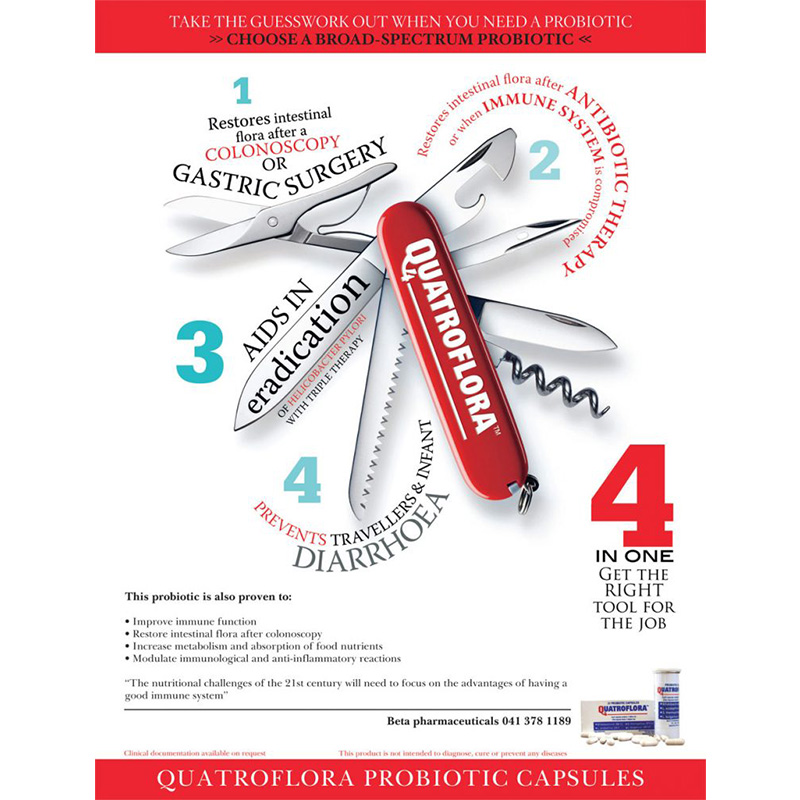


Why it’s smart to take QuatroFlora…
A normal healthy gastrointestinal tract contains approximately 1.5 kg bacteria and other micro organisms. Some factors like disease, increasing age, treatment with some medications like antibiotics, and colon cleansing for colonoscopy or certain radiological procedures, greatly reduce this number of micro-flora.
As many as 60% of diseases begin in the gastrointestinal tract – Imbalances lead to a number of unpleasant conditions like diarrhea, constipation, bloating, IBS, allergies, poor digestion and poor nutrient absorption. The bacteria in our digestive system manufacture substances that can either raise or lower our risk of disease, impact the effectiveness of medication, influence our immune response, or nutritional status and our rate of ageing. Clearly, intestinal bacteria are worth paying attention to.
A total of 100 trillion bacteria live in our digestive system, in either a symbiotic or antagonistic relationship. That is ten times more intestinal bacteria than there are cells in the body. Some groups of bacteria can cause acute or chronic illness, but another group of bacteria offers protective and nutritive properties. These friendly bacteria are called intestinal flora or probiotics. Probiotics are live micro-organisms that, when consumed in adequate amounts, confer a health benefit to the host.
The two most important groups of intestinal flora are Lactobacilli – found mainly in the small intestine, and Bifidobacteria – found mainly in the colon.
These bacteria are critical for normal development of the intestine and for defense against infections, and are vital for our health.
Bacteria in the gut are known to:
Probiotics may act through:
The probiotic strains in QuatroFlora™ have well documented effect on restoring bacterial balance in the intestine and thereby enhancing gastrointestinal well being.
The high level of documentation gives it the opportunity to stand out by showing that the product is well researched in terms of having a positive effect on intestinal health.
There is therefore no reason to suffer from diarrhea or other stomach upsets after antibiotic treatment or while traveling and enjoying a holiday of a lifetime.
Based on study results, we recommend QuatroFlora™ capsules containing
Bifidobacterium, BB-12®, Lactobacillus acidophilus, LA-5® , Lactobacillus bulgaricus, LBY-27 and Streptococcus thermophilus, STY-31 strains of probiotic bacteria for improving gastro-intestinal health and well-being
All probiotics are not the same:
Gastro-intestinal problems affect all of is at some time or another. Diarrhoea, constipation, bloating and the like are often caused by over-indulgence or eating something that doesn’t agree with us, and quickly clear up of their own accord.
Distressing and unpleasant conditions such as these can, however become chronic – and that can be caused by a bacterial imbalance in the intestines.
Some groups if bacteria can cause acute or chronic illness, but another group of bacteria offers protective and nutritive properties. Imbalances between the two can lead to a number of unpleasant conditions such as diarrhoea, constipation, bloating, IBS, allergies, poor digestion and poor nutrient absorption. In laboratory investigations, some strains of LAB (Lactobacillus bulgaricus) have demonstrated anti-mutagenic effects thought to be due to their ability to bind with heterocyclic amines, which are carcinogenic substances formed in burnt red meat.
The two most important groups of friendly intestinal flora or probiotics are Lactobacilli – found mainly in the small intestine, and Bifidobacteria – found mainly in the colon.
Probiotics are live micro-organisms that, when consumed in adequate amounts, have strong health benefits.
Beneficial bacteria in the gut are known to:
QuatroFlora™ capsules contain the following strains of probiotic bacteria for improving gastro-intestinal health and well-being:
Irritable Bowel Syndrome is a common disorder with challenging treatment
Findings in modern physiology are in full accord that nothing in our bodies act in isolation. No interaction is as surprising as the intimate dance between the beneficial bacteria of our gut and the delicate synapses in our brain, mediated by the microbiota-gut-brain axis.1,2 Who would have thought that the denizens of our gastrointestinal tracts are able to modulate some of our most sophisticated brain functions, such as memory, cognition and the stress responses?3 It is this close link between gut and brain that explains why sufferers of certain gastrointestinal disorders also present with high incidences of psychopathology, or why chronic stress can cause stomach ulcers.
Irritable bowel syndrome (IBS), the most common gastrointestinal disorder of our age, is no exception. For the approximately 11% of the global population that suffer from IBS4 – chronic abdominal pain, accompanied by bloating, flatulence, constipation and diarrhoea is not the sum of the debilitating symptoms. For many, this common set of gastrointestinal symptoms walk hand in hand with elevated levels of stress and anxiety5, changes in the activity of the hypothalamic-pituitary-adrenal axis6 and alterations in cognition patterns.7,8
Despite a clear picture emerging of the range of symptoms associated with IBS, the exact cause of the syndrome is still largely unknown. This complicates the treatment of this disorder. Consequently, frustrated physicians mainly end up treating the symptoms, without an inkling of the cause. To this end, several chemical drugs are employed that target specific symptoms, but none of them have satisfactory long-term effects on patients who may well spend a lifetime suffering from chronic IBS.9 Because of this, many patients turn to alternative remedies, with minimal success.9
Unlike these treatments, probiotics have proven themselves to be quite successful in alleviating general symptoms of IBS, with none to minor adverse effects even after long-term use.10,11 Indeed, even in healthy individuals, treatment with probiotics can improve memory and alleviate stress, in addition to the beneficial effects on the digestive system.3 In patients with IBS, certain probiotic strains reduce bloating and abdominal pain, alleviate general symptoms and improve the overall quality of life.10,11 The secret to success in the case of probiotics does not solely rely on their ability to reset the imbalance in the natural gut microbiota and play a non-invasive part in gut ecology.12 Rather, these live bacteria play a direct role in the affected microbiota-gut-brain axis, in effect not just targeting a single symptom, but a range of gastrointestinal, as well as psychological, symptoms.12 The implication of abnormal gut microbiota in the initiation of IBS is underscored by the fact that IBS presents itself in many patients following a bout of gastroenteritis – inflammation of the gut caused by bacteria that greatly disturb the natural gut microbiota.13,14 In the long run, probiotics have salubrious effects because they normalise gut microbiota, which in turn affects the health of the gut and, via the microbiota-gut-brain axis, the brain, thereby targeting a whole suite of symptoms.
In the light of the plethora of probiotic treatments on the market that all claim to rebalance gut microbiota, it is wise to remember that in the world of probiotics, as in the world of men, all strains are not equal.11 Some probiotic strains provide no relief of the symptoms of IBS, whilst others provide only mild relief to some patients.10,11 All in all, the multi-strain approach seems to be superior to treatment with single strains of bacteria, probably because they align with the natural diversity of the gut environment.15 In general, it is therefore prudent to use a probiotic in the treatment of IBS with proven clinical efficiency in a randomised, double-blind, placebo-controlled clinical trial.
In a recent study on 108 Iranian adults, one of the populations with the highest worldwide prevalence of IBS, 85% of the participants who received a multi-strain probiotic, Probio-Tec® Quatro-cap-4, reported relief of general symptoms after four weeks of treatment.16 In particular, there was a marked reduction in abdominal pain, bloating and rectal tenesmus in comparison to those participants who received the placebo.16 Some degree of relapse was seen in the symptoms ten weeks after discontinuation of the treatment, a reminder that even though probiotics can treat symptoms, a cure for IBS is yet to be found.16
The multi-strain probiotic, equivalent to QuatroFlora® in South Africa, investigated in this trial, combines four strains of beneficial bacteria, namely Bifidobacterium animalis subsp. lactis BB-12®, Lactobacillus acidophilus LA-5®, Lactobacillus delbrueckii subsp. bulgaricus LBY-27 and Streptococcus thermophilus STY-31, that colonise the small bowel and the colon. Together, these bacterial strains have a greater effect on abdominal symptoms when compared to the effect of each species acting alone.15 In conjunction, these bacteria contribute to a more normalised gut environment17 and suppress pathogenic bacterial growth18, both factors that might disturb the microbiota-gut-brain axis.12 Likewise, these bacteria support the immune system, which has been shown to be markedly affected in patients with IBS.19,20
There is no miracle cure for IBS. For that to be found, the real cause of IBS must be elucidated first. Nonetheless, for now, probiotic treatment is by far superior to other chemical drugs and is safe for long-term use. Probiotics not only rebalance the delicate environment of our guts, but also play into the microbiota-gut-brain axis so that the most unlikely of pairs can live in harmony.
References
Clinical Research on Probiotics: The Interface between Science and Regulation
Carmen Tamayo + Author Affiliations
Flora Inc. USA, Bethesda, Maryland
Reprints or correspondence: Dr. Carmen Tamayo, Research and Development Director, Flora Inc. USA, 8003 Thornley Ct., Bethesda, MD 20817 ( ctamayo2@comcast.net).
Abstract
Although there exists some evidence of the safety and efficacy of probiotics for treatment of disease, many of the clinical trials have lacked methodological quality, particularly with regard to protocol design, selection of population, and product characterization. Depending on the regulatory route, data need to be collected carefully to satisfy regulatory requirements in the United States and elsewhere. This article discusses how the regulations for probiotics affect clinical research. It also describes clinical trial design and issues that affect the design of trials for probiotics conducted to improve the scientific evidence for these products.
Placebo-controlled randomized clinical trials (RCTs) have demonstrated the clinical efficacy of probiotics for functional gastrointestinal problems [1–5], and preliminary studies show some benefits of probiotics for atopic diseases, food allergies, and inflammatory bowel disease [6–13]. However, probiotic trials suffer from shortcomings similar to those of trials for dietary supplements: small sample size; lack of appropriate randomization, allocation concealment, or blinding; different periods of treatment and different doses; lack of product characterization; ill-defined patient populations; lack of data on etiology and severity of disease; and potential confounding factors. Although some recent trials have corrected these failings, there are still inadequate data to draw valid conclusions about many conditions. Also, major meta-analyses and systematic reviews have yielded conflicting results [14–17].
The lack of a uniform definition of “probiotics,” as well as the lack of characterization of specific strains, designation of appropriate doses, and conformity to required product characteristics [18–20]—all of which have been described at great length in previous articles in this supplement—are major issues that need to be addressed for the design of good trials. A viable probiotic agent should display nonpathogenic properties, the same features as the strain itself, the ability to survive transit through the gastrointestinal tract, adherence to intestinal epithelium, colonization in the intestinal tract, production of antimicrobial substances, and a good shelf life (stability) in food or powdered form [18]. Unfortunately, not all probiotics tested in clinical trials meet these requirements.
Because probiotics may confer potential health benefits by preventing or treating specific pathological conditions [8, 9, 21–23], they are often used as “drugs.” Currently, few (if any) probiotics are able to meet the manufacturing requirements for drugs [24, 25].
Both US and European markets for probiotics are set for emphatic growth in the coming years, despite widespread consumer ignorance about probiotics and their benefits to the human body [26]. Major concerns exist about the widespread use and quality of probiotics. Up to half of the “friendly bacteria” products sold are ineffective, and some may even be harmful [27]. No international consensus exists regarding the methodology used to assess the efficacy and safety of these products, and only specific brands have proven effects [2]. Considerable differences exist in bioavailability, biological activities, doses, and composition among probiotic preparations.
The document from the Food and Agriculture Organization of the United Nations and the World Health Organization refers to probiotics only as food, thus precluding them to be used as biotherapeutic agents or drugs [2]. The report, however, underscores the need for taxonomy, definition, and measurement of health benefits, including the minimum daily amount required to confer an effect, and the need for sample sizes large enough or powered to determine an effect. With respect to evaluation of probiotics for use in food, the strain must be identified and functionally characterized on the basis of in vitro and animal studies. Safety should be assessed for new strains on the basis of in vitro and/or animal studies and phase 1 and 2 clinical trials.
With the emergence of the hygiene hypothesis, the role of bacteria in host health is being reconsidered. Probiotics are being used to treat disease. However, this poses a major challenge because of their regulation as foods and dietary supplements. The current market refers to them as “microorganisms which when consumed in adequate amounts, confer a health effect on the host, preventing, cure, mitigating or treating a disease” which, for the United States, is akin to the claims for drugs [25]. Health claims for probiotics range from general claims, such as “regulation of bowel activity or increased well-being,” to more specific claims, such as “exerting antagonistic effect on the gastroenteric pathogens or for the treatment of IBS [irritable bowel syndrome]” [28, 29]. Differences in health-related claims applicable to probiotics, related concepts, and marketing implications are discussed in this supplement [25, 29–31] and are reviewed elsewhere [32, 33–38].
Product labeling should provide consumers with correct and relevant information. At a minimum, the manufacturer must have data to support the identity, potency (i.e., number of viable organisms to which a consumer will be exposed after consumption within the established time frame to expiration), purity, and quality of the product [39].
Although probiotic research has been conducted for the past 28 years, variability in study design, type of probiotic, dose, and duration of treatment have yielded contradictory results [14]. Within the past decade, a large number of scientific studies have addressed mechanisms of action of certain probiotic strains. However, in vitro effects of a probiotic may be opposite of the behavior in vivo, which represents an important objective of current investigations.
Clinical trials seldom report adverse effects and may lack the power or duration to identify them. Thus, population-based samples may be better for assessment of probiotic safety. RCTs are often considered the best methodology for drawing inferences regarding the efficacy of a therapy. Difficulties in interpreting RCTs, particularly lack of generalizability and heterogeneity of the therapeutic effect, may be challenging. Some patients benefit from experimental therapy, whereas others do not benefit and may even be harmed. Nevertheless, RCTs remain the gold standard for evaluation of safety and efficacy of an intervention and should be designed carefully. Previous dose-range studies may be needed to ensure efficacy, and study designs should be selected with care. Well-controlled observational studies and evolving effectiveness studies may also provide valuable evidence.
Clinical trial objectives may vary according to the purpose of the research. For investigator-initiated research, the objectives might be (1) to ascertain safety and efficacy, (2) to identify adverse events related to use, and (3) to discover or verify clinical, pharmacokinetic, or pharmacodynamic effects. Conversely, for research initiated by manufacturers, the purpose may be only to validate or substantiate a health related claim.
To validate a claim, the proposed relationship between the product and the health-related end point should be identified, and appropriate measurements of both should be indicated. The interests of patients and consumer involvement are becoming integral parts of clinical development and should be taken into consideration. Effective funding and collaboration among industry and academic institutions are key for proper development of probiotics.
Probiotic drug development may start at any time in the process and may, in fact, be done “backwards” (compared with the development of conventional drugs), starting with RCTs if a product is well-characterized and if there is sufficient information on previous experience in humans. Phase 3 clinical trials, in this case, should compare the efficacy of the investigational product against that of a placebo, the best available treatment, or both.
Future research should focus on determining the mechanisms of action, evaluating the probiotic interactions, and elucidating how the genetic and bacterial profiles of the patient can influence treatment responsiveness. Gastrointestinal functional assessment, mucosal-integrity laboratory methods, and response-efficacy instruments are paramount to effective research [4]. Combination approaches (e.g., probiotics and prebiotics combined) may offer new therapeutic options [40]. The remaining challenges include identifying the mechanisms of action, to provide the basis for more-refined hypothesis-driven clinical trials, including immunomodulation [41].
For regulatory purposes, health-related claims require sound evidence from all available sources. Positive evidence should not be outweighed by negative evidence, and sufficient evidence based on human experience should be available to support safety and efficacy, including pre- and postmarketing experience, when applicable. The greater the consistency of evidence from different sources, the stronger the evidence will be.
The primary regulatory obligations of manufacturers and marketers should include product safety and accurate descriptions of product identity, composition, and indications in the label and product inserts. Claims for regulatory purposes are dependent on the level of evidence and the design of the clinical trial. In addition, product-specific evidence based on high-quality investigations should be emphasized [42, 43]. In summary, future large-scale clinical trials that control dosing, viability, and other critical variables will be crucial for providing the necessary scientific evidence required to determine the efficacy of the increasingly used probiotics.
Acknowledgments
Supplement sponsorship. This article was published as part of a supplement entitled “Developing Probiotics as Foods and Drugs: Scientific and Regulatory Challenges,” sponsored by the Drug Information Association, the National Institutes of Health National Center for Complementary and Alternative Medicine (1R13AT003805-01 to Patricia L. Hibberd), the California Dairy Research Foundation, Chr. Hansen, the Dannon Company, General Mills, Institut Rosell, and Yakult International.
Potential conflicts of interest. C.T. works as a consultant for Flora Manufacturing and Distributing (Burnaby, British Columbia) and Flora Inc. USA (Lynden, Washington). Flora distributes but does not manufacture probiotic products. However, no part of this work was sponsored or supported by Flora.
References
Sign up for our latest news and updates!

By continuing the use of our Website, you are explicitly and actively consenting to our processing of your personal information as per our Privacy Policy.